A warning, because I'm nice like that: Some of the images in this post and the next ones to follow will be pretty damn gross, so for all you squeamish people and vegans out there, you might just want to avert your eyes whenever the text stops. As the Man in Black said to the abductee: You've been warned.
IT BEGINS
It started, like disco, Afros, and Satan-possessed-my-car horror movies, in the seventies. Some, like the Snippy/Lady case (which will be brought up in another post, one of its own, because it requires a lot of room), happened in the late sixties, but by the early seventies everything was really getting into full swing.
According to Unexplained! Strange Sightings, Incredible Occurrences and Puzzling Physical Phenomena (2nd edition) by Jerome Clark, in "the fall of 1973, farmers in Minnesota and Kansas reported that their cattle were dying under mysterious circumstances." The animals appeared to have been killed "without knife or bullet" and the missing parts had been removed "with surgical precision." Even more puzzling than that (I know, amazing that something could be even more puzzling than that, right?) was the fact that absolutely no clue (footprints, tire tracks, all that good stuff that gets hundreds of murderers and muggers caught every day) had been left behind by the sick freaks that had done it.
Deputy Gary Dir of Ottawa County, Kansas, stated, echoing the bewilderment of many law-enforcement officers of the time, "The large majority of these mutilations occurred near occupied houses. In no instances were the animals found less than a quarter-mile from the roadside and none...more than a quarter-mile from an all-weather, well-traveled road." (Unexplained!)
 |
| Poor Bessie. |
Law enforcement officials and farmers were equally bewildered as more and more cattle showed up dead, and still there were no clues to the identity (or identities) of who- or whatever was responsible for the killings. As time went on, it was revealed that most of the "mutes" shared several characteristics, which I've helpfully compiled in a neat little list for you guys keeping track at home.
- Lights in the sky. These lights--and, occasionally, objects--were often spotted in the sky just before or just after a mutilation was found, most of the time hovering above or near where the cow was found. In the "Alien Cowboys" episode of the National Geographic show Chasing UFOs, the team headed down to the San Luis Valley, a hotbed of recent mutilations, and learned that every time these mysterious lights were spotted in the sky at night, a few days later a dead cow would show up.
- Helicopters and vans. Black ones that appear to possibly be military but without any identifying logos or insignias have been known to show up, possibly tracking whatever is killing the cattle. White trucks or vans have also been spotted, some with government plates (but no, they don't know anything at all, remember that), in the areas.
- No blood or bone dust. Usually there were small holes in the dead animal's throat, in the jugular vein (hey, maybe it's Dracula), and there was no blood around the wounds or on the ground, and nobody can ever account for where the blood might have ended up. There was some evidence that suggested at least some of the cattle were alive--unconscious, but alive--when the blood was drawn; sometimes evidence of a tranquilizer was found in the dead animal's system. Also, when pieces of bone had been cut through there was no dust left behind. But still, where did it all go? As Sheriff Ray Lee of Cheyenne County, Kansas, put it when he commented on the lack of blood: "You couldn't cut up an animal like that without getting nasty."
- High-level anatomical knowledge. The cuts were often surgical-like in nature, and some gave the indication that surgical tools were used as well, although some of the work was done so well that Oklahoma State University vets said their students couldn't replicate what whoever the culprit was had done.
- High heat. Sometimes cuts appeared to have been cauterized with high heat to stop blood loss around cuts and blood vessels, as if with laser technology. The problem with that? We didn't have any laser technology that could do that back then. Some of the cut skin had been roasted to a toasty 300 degrees Fahrenheit, but the cells weren't damaged at all. We still don't have any tech that could do that.
- No tracks or traces. One dead cow was found dead in a fresh mud hole, but there were no tracks around it at all. Even in cases where the animals appeared to have been moved from one place to another, there were no marks indicating how or by who.
- Movement. The missing blood at the sites could be possible if that was not the area where the animal had been killed. Most cases showed that the dead animal had been moved from one place to another, where it was found, and even if there was no evidence to show by who, there was evidence to show they had been moved: Some had broken limbs or spines, or parts like horns were pushed into the ground, like they had been dropped. Not just moved, but dropped, from some significant height. This was also echoed in the reports in "Alien Cowboys," where one cow was even found in the snowy bank of a river but there were no skid marks there to show if she had fallen from the top of the bank and died. Also, her parts were missing. One cow was found in a tree.
- Missing parts. Many of the organs taken in each case were the same, and these include: eyes, tongues, genitals, ears, pieces of bone such as jaws, udders in female cows, lips, rectums, and tails, with the genitals and udders being taken the most often. And, of course, the blood was missing.
- Burn marks. Many of the animals were found in rings of burned or singed grass, or these were found nearby, along with crops flattened in a circle. Sometimes the carcass tested positive for trace levels of leftover radiation, and a research experiment showed that many times predators such as coyotes and crows actively avoided the mutilated carcass, which would help explain why many don't show any signs of scavaging or predation.
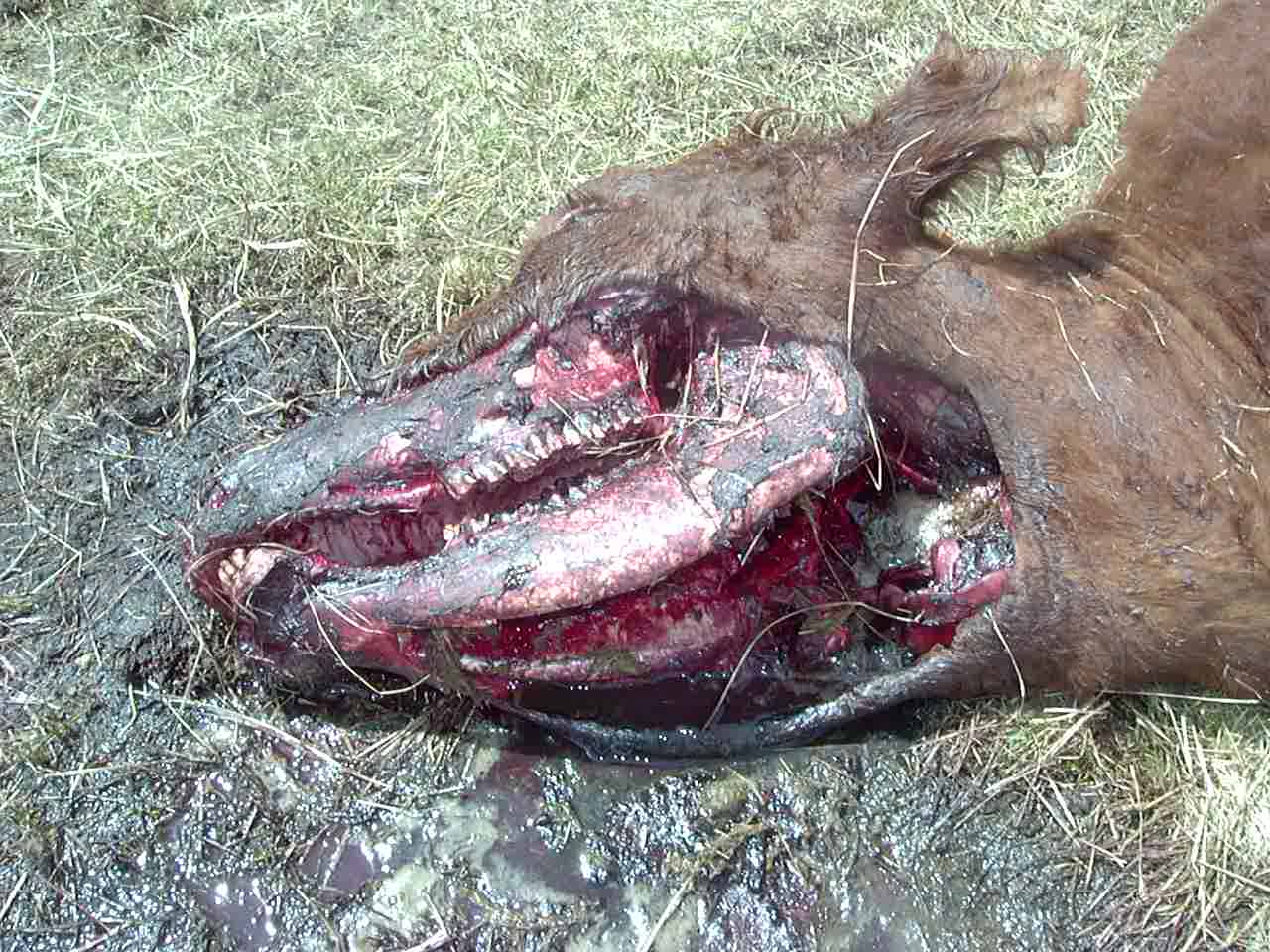 |
| Aw, who wouldn't find that appetizing? |

No comments:
Post a Comment